A Unique Experience in Surround Sound
How Russia’s First Large-Scale Open-Air Immersive Orchestral Sound Project Was Created for the G20 Summit
Immersive Audio for G20 Summit: Orchestral Surround Sound
In September 2013, Saint Petersburg became the center of global politics as Russia hosted the G20 Summit — one of the most important international events in the world. The summit brought together heads of state, presidents, prime ministers, and leaders of the world’s largest economies to discuss key issues affecting the future of global finance, international cooperation, geopolitical stability, and economic development.
The significance of such an event extended far beyond formal negotiations. Every detail of the summit environment mattered, including the cultural program created for the attending world leaders. These performances were not simply concerts or ceremonial entertainment. They formed part of the international image of the host nation and represented the country’s cultural, technological, and organizational level before the most influential political figures on the planet.
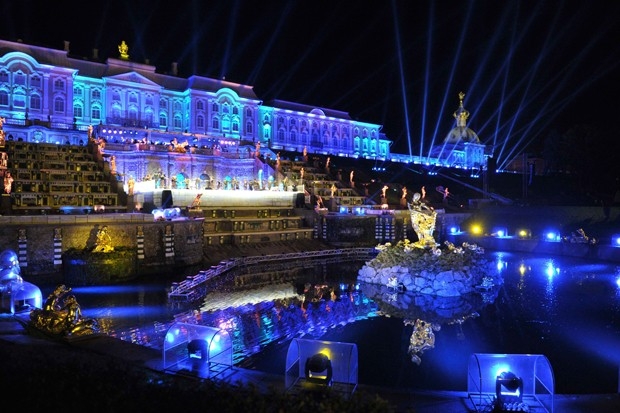
It was in this context that I was appointed Chief Sound Engineer of the cultural program of the G20 Summit, held on 5–6 September 2013 at one of Russia’s most symbolic and visually complex open-air locations — the Fountain Square of Peterhof Palace.
What made this production exceptional was not only its political importance, but the fact that it required solving a sound design challenge of extraordinary complexity in an outdoor environment under conditions where conventional reinforcement methods could not deliver the desired artistic result.


A Technically Extreme Environment
The main stage was positioned at a great distance from the official guest tribune. The seating area for the heads of state and high-level delegates was located more than 80 meters away from the performance area. Between the stage and the tribune there was an active fountain complex and a canal, creating not only physical separation, but also a difficult acoustic and visual environment.
In a standard open-air setup, such a distance would inevitably create a compromise. A traditional frontal system alone would not have allowed the audience in the official seating area to experience the orchestra with clarity, intimacy, natural localization, and tonal balance at the level required for such a prestigious event.
The challenge was clear:
it was necessary not just to make the performance audible, but to reproduce it at the highest artistic level for the leaders of the G20 states — with maximum intelligibility, musicality, natural spatial perception, and emotional impact.
A Historic Decision: Creating Russia’s First Open-Air Immersive Distributed Orchestral Sound System
At that moment, I made a decision that became a turning point not only for this production, but in many ways for the development of immersive live sound practice in Russia.
Instead of relying solely on a conventional left-right front-of-house approach, I designed and implemented a distributed sound reinforcement concept for the official guest tribune, aimed at creating a true sense of immersion, spatial depth, and orchestral presence.
This was, in practical terms, the first project of this kind in Russia:
a large-scale open-air immersive orchestral sound solution, built specifically for a top-level international event, with the goal of preserving both the musical balance of a live orchestra and the natural spatial image of the source on stage.
To realize this concept, more than 40 compact loudspeaker systems were placed around the perimeter of the guest tribune. These loudspeakers were organized into 20 independently routed groups, each with its own signal assignment and control.
This gave me 20 discrete distributed output channels surrounding the official audience area.
But the key idea was not simply to “surround” the audience with sound. The main artistic objective was to preserve a strong and convincing psychoacoustic connection between what the listeners heard and what they saw on the stage. Sound had to remain naturally tied to the visual source. It was essential that the audience did not perceive the system as a set of separate loudspeakers, but rather as a single coherent sonic image originating from the performance space.
To achieve this localization anchor, an additional frontal reinforcement system was installed directly in front of the tribune in a Left–Right–Center ground-stacked configuration with subwoofers. This frontal layer acted as the visual and directional focus of the sound image, while the distributed system around the tribune extended depth, presence, warmth, and immersive orchestral envelopment.
As a result, the official guest area was served by a total of 24 output channels:
- 20 distributed perimeter channels
- 4 frontal channels (L, R, C, Sub)
For an outdoor state-level event in Russia in 2013, this was an unprecedented concept.
More Than 100 Inputs and 20 Dedicated Immersive Submixes
The complexity of the project did not end with system design.
The performance involved a live orchestra, and more than 100 microphone channels arrived from the stage to the console. This meant that the task was not only technical, but deeply musical and creative.
I had to build:
- the main frontal orchestral mix,
- and at the same time
- 20 dedicated submixes for the distributed loudspeaker groups surrounding the tribune.
This was not a case of simply duplicating the same mix to multiple outputs. Each group required thoughtful signal distribution, balance control, and spatial logic. The goal was to preserve orchestral integrity while creating a highly immersive listening field that remained elegant, natural, and emotionally persuasive.
The work demanded extremely careful decisions in:
- level structure,
- tonal balance,
- instrument placement,
- depth perception,
- localization,
- and the interaction between frontal and distributed reinforcement.
The artistic challenge was especially important. A symphony orchestra cannot be treated like a pop playback system. It has internal geometry, hierarchy, natural spread, and expressive movement. If reproduced incorrectly, it loses realism and becomes flat or artificial. My aim was the exact opposite: to create a listening experience in which the audience would feel not merely that the music was loud enough, but that they were immersed inside a living orchestral space.
The Result: Full Immersion with Natural Localization
The final result exceeded conventional expectations for outdoor sound reinforcement.
Using the console as a creative spatial instrument, I achieved a sonic image in which the orchestra did not feel distant, detached, or merely amplified. Instead, it felt surrounding, present, close, and emotionally involving, while still preserving the correct orchestral balance and the sense of stage-originated performance.
The most important achievement was this:
the official audience experienced an effect of full orchestral immersion without losing natural localization.
The music seemed to envelop the listeners from all sides, but it still remained clearly connected to the stage. This created a highly convincing perceptual illusion of proximity and realism.
As was later noted by listeners and representatives present at the event, when an instrument positioned on one side of the orchestra began to play a solo, the reproduction felt so natural and believable that there was an instinctive desire to turn one’s head toward that side and look more closely — as if the source were physically present within immediate reach.
That response is one of the strongest indicators of success in spatial orchestral reinforcement. It means the sound is not only technically correct, but psychoacoustically persuasive.
For an audience consisting of world leaders and heads of state of the G20 summit, this level of result carried special importance. The cultural program was experienced not as background accompaniment, but as a high-level artistic and technological presentation of Russia’s capabilities. Achieving such a response under these conditions was an exceptional professional recognition.
The First in Russia
What makes this project especially significant in my career is that it was not simply “a difficult concert” or “a large outdoor show.”
It was, in essence, the first Russian open-air project in which an immersive distributed orchestral sound concept was realized at this scale and at this level of artistic precision.
At the time, this approach had no established local precedent in Russia for state-level outdoor orchestral reinforcement of this type. It required not only engineering skill, but also the willingness to think beyond traditional sound system design and to create a completely new practical model adapted to the space, the audience, and the political importance of the occasion.
This is why I consider that project a historic milestone:
it was the moment when immersive live orchestral sound in Russia moved from concept to real high-profile implementation in front of the most important international audience possible.
Recognition at the Highest Level
For the successful realization of the cultural program at a high artistic and professional level, I received a state award and was also officially recognized by the leadership associated with the event.
For me, however, the most important recognition was broader than any formal distinction. It was the fact that the result achieved exactly what the event demanded:
a world-class listening experience for the leaders of the G20 states, delivered under extremely complex open-air conditions, with artistic credibility, technical innovation, and maximum perceptual impact.
That combination of innovation, execution, and reception made the project one of the defining achievements of my professional career.
The Beginning of a Long-Term Direction in Immersive Audio
This project became the starting point for my deeper work in immersive sound and spatial audio design for major productions.
Although Meyer Sound had already introduced its D-Mitri platform in 2009, at the time of the G20 cultural program such technology was not yet available in Russia. Therefore, the Peterhof project was realized through advanced creative system thinking, console-based routing architecture, and a highly detailed manual approach to immersive mix construction.
Later, the Meyer Sound D-Mitri system was acquired and installed at the State Kremlin Palace, where I served as head of the sound engineering department. This opened new opportunities for high-level implementation of immersive and spatial audio concepts in large-scale productions.
Today, I am a certified Meyer Sound D-Mitri user, and over the years I have prepared and delivered many productions using immersive sound principles, spatial effects, and advanced multi-channel system architecture.
In that sense, the G20 Peterhof project was not an isolated success. It became the practical foundation for a much larger professional path — one that later developed into systematic work with immersive technologies at the highest institutional and production level.
Professional Philosophy
This experience confirmed a principle that continues to define my work:
Immersive sound is not just about the number of channels. It is about perception, localization, emotional depth, and the ability to preserve the artistic truth of a performance in any environment.
For me, the purpose of sound design in large-scale orchestral and ceremonial productions is never simply to make the audience hear.
The goal is to make them feel physically connected to the music — naturally, convincingly, and emotionally.
At the G20 Summit in Saint Petersburg, in front of the leaders of the world’s most powerful nations, I had the opportunity to prove that such a result was possible in Russia for the first time in a truly unique open-air setting.
And that experience became the beginning of everything that followed.